Navigation

    Voting Theory Forum

    • Register
    • Login
    • Search
    • Recent
    • Categories
    • Tags
    • Popular
    • Users
    • Groups
    1. Home
    2. clay
    C
    • Profile
    • Following 0
    • Followers 0
    • Topics 2
    • Posts 34
    • Best 5
    • Groups 0

    clay

    @clay

    7
    Reputation
    2
    Profile views
    34
    Posts
    0
    Followers
    0
    Following
    Joined Last Online

    clay Unfollow Follow

    Best posts made by clay

    • score voting is king, condorcet not so much

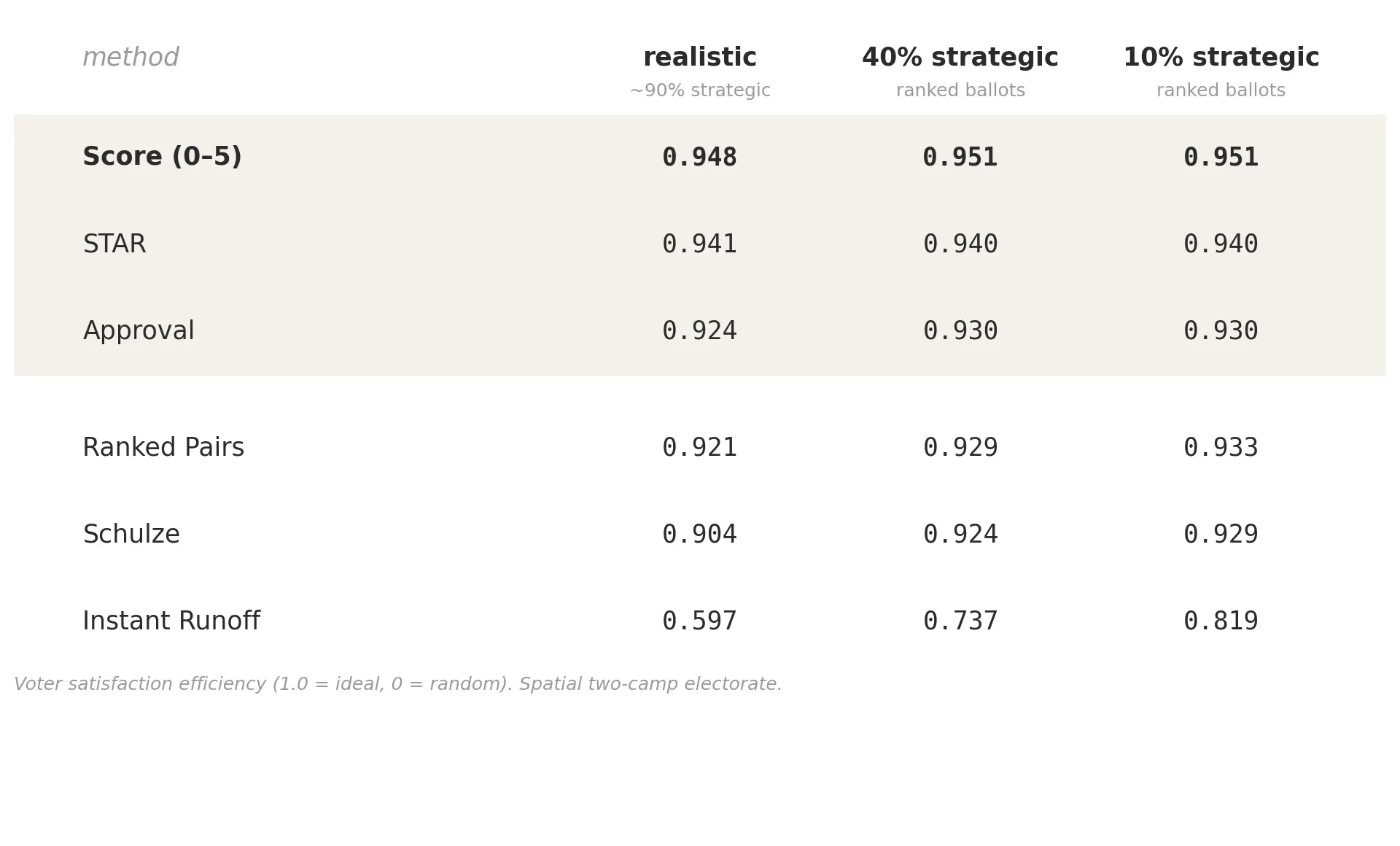
      Many people treat Condorcet's VSE edge as settled. It isn't. It rests on two assumptions that quietly do all the work: that voters perceive viability perfectly, and that they mostly vote honestly. Relax either and it collapses.

      I took Quinn's VSE engine and made one change. His runs let strategic voters read the true standings exactly, so their strategy is always aimed at genuinely weak candidates and barely dents Condorcet. I replaced that with a viability signal that's 50% true, 50% random, since real electorates misjudge who can win all the time (a Democrat written off in a red state, etc.). Now strategy sometimes buries a candidate who'd actually have won, the favorite-betrayal failure cardinal methods are immune to. (STAR voting technically isn't, but voters strategize intuitively would have no idea how STAR actually works, in real life—so just assume it's score voting.)

      Then I rigged the rest in Condorcet's favor: cardinal methods (0–5 score, approval, STAR) run at 90% strategic; Condorcet methods get a very favorable 10% and a favorable 40% strategic. Maximum strategy against the cardinal methods, little against the ordinal ones.

      Spatial bimodal electorate (two ideological camps, candidates along the axis):

      method regime VSE
      Score (0–5) 90% strat 0.946
      Ranked Pairs 10% strat 0.932
      Schulze 10% strat 0.929
      Approval 90% strat 0.924
      Ranked Pairs 40% strat 0.918
      STAR 90% strat 0.918
      Schulze 40% strat 0.913

      Polya / urn electorate (Quinn's default):

      method regime VSE
      Score (0–5) 90% strat 0.876
      Ranked Pairs 10% strat 0.870
      STAR 90% strat 0.865
      Approval 90% strat 0.858
      Schulze 10% strat 0.855
      Ranked Pairs 40% strat 0.854
      Schulze 40% strat 0.846

      Even with the deck stacked this hard, fully strategic Score beats every Condorcet configuration on both models, including the most favorable. And once a realistic 40% of Condorcet voters strategize, strategic Approval passes Ranked Pairs on both and beats Schulze across the board.

      The spatial model, if anything, favors Condorcet: it puts voters and candidates on a real ideological axis where head-to-head comparisons mean the most. Score wins there anyway.

      The strategy model is just frontrunner polarization, what plurality voters already do reflexively: "I don't think X can win, so I'll bury them and rank the viable compromise first." Biden > Warren > Trump, Cornyn > Talarico > Paxton. The honesty-and-perfect-viability assumptions are the only thing holding Condorcet's edge up, and neither survives contact with how people actually vote.

      (±95% CIs ≈ 0.005 spatial, 0.009 Polya. Built on Quinn's engine with a half-random viability signal; happy to share the patched code.)
      posted in Voting Theoretic Criteria
      C
      clay
    • RE: score voting is king, condorcet not so much

      @toby-pereira said in score voting is king, condorcet not so much:

      It's been said that score suffers worse with one-sided strategy than other methods. That is - if the supporters of one candidate strategise more than the supporters of another, then the result will be more skewed (favour the strategisers) under score than some other methods. Would you agree with that, and do you see it as a problem?

      I ran it on a spatial bimodal electorate with a realistic (half-random) viability signal, average strategy pinned at 90%, comparing symmetric (90% of each faction strategizes) against the most lopsided split possible at that level (100% of one faction, 80% of the other).

      method 90/90 symmetric 100/80 asymmetric change
      Score (0–5) 0.943 0.933 −0.010
      Approval 0.926 0.921 −0.005
      STAR 0.914 0.905 −0.009
      Ranked Pairs 0.874 0.859 −0.016
      Schulze 0.863 0.840 −0.022

      So at a fixed strategy level, adding maximum asymmetry costs Score about a point, and costs the Condorcet methods more, Ranked Pairs −0.016, Schulze −0.022. Approval is the most robust of all. The ordering of who's hurt is the reverse of the claim: one-sided strategy is harder on the ranked methods here than on the cardinal ones.

      I'd agree the underlying property is real, score does respond to one-sided exaggeration. But two things keep it from being a problem in practice. The optimal score strategy is just threshold voting (approve/max everyone above your expected value of the winner), which is close to a sincere ballot, so the distortion per unit of asymmetry is small. And every method has an asymmetric-strategy weakness; the ranked methods' version is burial, which diverges much further from sincerity and does more damage, which is what the table shows.

      2886b1d8-338c-4f1c-b37b-c3a7b9ff865c-image.png

      posted in Voting Theoretic Criteria
      C
      clay
    • RE: Approval Voting as a Workable Compromise

      my latest on this.

      posted in Election Policy and Reform
      C
      clay
    • RE: election by jury (www.electionbyjury.com/manifesto)

      @cfrank well thank you very much for reading it. I know it is very long but I think anyone looking to seriously consider and criticize the system should read it so I'm glad you did.

      there is no perfect information environment but I'm just saying it's better than any other solution that could possibly be created. and how sequestered you are is completely tunable. in principle you could sequester the jury 3 months ahead of the election or a year ahead of the election or two years agrad of the election if you think it's really that important. I'm not particularly taking any stance on that.

      posted in Voting Method Discussion
      C
      clay
    • RE: election by jury (www.electionbyjury.com/manifesto)

      @toby-pereira ok toby, sure.

      posted in Voting Method Discussion
      C
      clay

    Latest posts made by clay

    • RE: election by jury (www.electionbyjury.com/manifesto)

      @toby-pereira

      being a better speaker is already an advantage in our present system. "I don't know what he said. I don't think he does either."

      having hours upon hours and days upon days of adversarial interrogation by the other candidates Will take us as far as is physically possible toward minimizing The impact of that bias relative to the impact of the bare facts.

      Will this change people? absolutely that's the whole point. we want them to be statistically representative in terms of their intrinsic preferences, not their instrumental preferences. we want the electorate to get what they would have gotten if they had all gone through the same process.

      Will this make people tune out of politics? God willing. why should anybody have to care about how their computer operating system is working? they just want it to work. and an ideal world we barely even talk about political issues. we know we have a process that matches policy to our collective well-being as accurately as is humanly possible and we pity all those countries using democracy and getting the kind of chaos we have now. we don't have anti-vaxxers running HHS.

      it's hard to say whether the public would react negatively. I haven't been able to find any negative public commentary about election by jury in Georgia. maybe we need to give people a few things they still vote on to address this. kind of like giving your kid a toy steering wheel dor the car.

      posted in Voting Method Discussion
      C
      clay
    • RE: election by jury (www.electionbyjury.com/manifesto)

      @toby-pereira ok toby, sure.

      posted in Voting Method Discussion
      C
      clay
    • RE: election by jury (www.electionbyjury.com/manifesto)

      @cfrank said in election by jury (www.electionbyjury.com/manifesto):

      @clay, there is no purpose in continuing this discussion with you. Your approach to discourse is unlikely to convince others, and it is not because you are right while everyone else is wrong. A good-faith response to a serious objection is to examine the premise and answer the question—not repeatedly declare the questioner confused.

      I have meticulously dismantled your arguments point by point.

      for example, you made the classic fallacy of thinking my arguments require interpersonal utility comparisons. but harsanyi's observation is that you don't need this at all. The outcome with the highest group utility will also have the highest expected utility for you in your own utility scale without any need to have the different utilities in common units.

      when you think about it for a second this is trivially obvious from grade school level mathematics. but I actually cited a voluminous link about it written by a math PhD who is widely regarded as the foremost expert in this field and you STILL just ignored it.

      My point here was not just "convincing", it is trivially obviously true. and you're in a forum that is literally called "voting theory"—yet you have chosen to not just spend a little time reading about the foundational principles of the field that literally any expert in the field is familiar with. you should really reflect on this. this would be like going into a climate change debate and saying climate change isn't happening because there was an unusually bad winter storm somewhere. anybody familiar with the topic would absolutely roast you for failing to grasp a multitude of basic scientific concepts that anybody up for a debate should have invested the time learning about.

      posted in Voting Method Discussion
      C
      clay
    • RE: election by jury (www.electionbyjury.com/manifesto)

      @cfrank said in election by jury (www.electionbyjury.com/manifesto):

      @clay, I introduced “normative” to mean questions about what institutions ought to do and what arrangements are justified.

      "ought" just means "would satisfy my preferences". if you say someone "ought" to do something, that's identical to saying, "i would prefer it if you would do that thing."

      similarly, "justified" means "satisfies my preferences". that's it.

      That is the standard use in political philosophy.

      show me any use of these words that you think constitutes "political philosophy", and i will demonstrate that it just means subjective preference. your lack of familiarity with basic social choice theory is astonishing.

      You may argue that normativity reduces to subjective preference, but that is your metaethical theory, and that conclusion has not been established here, nor is it the definition of the term.

      yes it has, and i just proved it. and you have zero counterargument.
      https://wonk.blog/ethics#isought

      You now appear to be defending total utilitarianism: for a given population, the best outcome is the one with the highest sum of utilities. That is a controversial normative principle, not something mathematics proves on its own.

      you're dead wrong, and this is proven.

      A theorem may show what follows from a chosen social-welfare function; it does not prove that summed utility is the uniquely correct standard of justice.

      you have this completely backward. the theorem proves what the correct social welfare function is. it does not use the social welfare function as a premise. you have absolutely no idea what you're talking about.

      Without an independently justified method for specifying and comparing utilities, the framework can be made to rationalize radically different outcomes simply by changing the utility assignments.

      this is a classic novice fallacy, thinking that utilities have to be in a consistent scale to be summed. this is obviously wrong, as harsanyi proved.

      it is amazing that you refuse to spend a few minutes learning about this topic before plodding in and making a series of confidently wrong arguments.

      Your own citation is substantially more cautious about interpersonal utility comparison than your claims here.

      it is not "cautious", it just explains the fact that i just explained to you in even more layman-friendly language with the hope that you might be able to grok it.

      Harsanyi's argument "Social Utility" is the average of individual utilities
      Let uk(e) denote the utility (according to individual k) of an event e. We want to investigate how to aggregate the individual utilities into a "social utility" saying "how good e is for all of society." For what reason should we claim that social utility is just the average of individual utilities?
      J.C.Harsanyi, in a 2-page article involving no mathematics whatever [J.Political Economy 61,5 (1953) 434-435], came up with the following nice idea: "Optimizing social welfare" means "picking the state of the world all individuals would prefer if they were in a state of uncertainty about their identity." I.e. if you are equally likely to be anybody, then your expected utility is the summed utility in the world divided by the number of people in it – i.e. average utility. Then by the linear-lottery property (Lin) of von Neumann utility, it follows that social utility is averaging.

      Regardless, your framework also seems to give rights, consent, sovereignty, self-determination, and distribution no independent force.

      it is not my "framework", it is just obvious factual reality. the only "force" people care about is their utility. preference sovereignty principle.

      why do you insist on plodding ahead making these kinds of vacuous statements when you could just spend a few minutes learning basic social choice theory?

      They apparently matter only insofar as they affect the utility total.

      "matter" literally means "has utility", so this is a lovely tautology.

      So I will ask again: if a large outside population gains many small benefits by confiscating nearly all resources from a smaller region whose residents suffer catastrophic losses, is that policy “by definition good” whenever the summed utility favors the outsiders?

      and i will repeat, again, that it is good to those who benefit, and bad to those who don't. maybe learn what the word "preference" means.

      Nor does “elections” solve the problem of cardinal interpersonal utility comparison.

      there is no "problem" of interpersonal utility comparisons, as i have voluminously explained to you. could you please try actually reading anything i sent you instead of repeating confused nonsense? this should only take a few minutes to read, and would save you a lot of time. and it would save me a lot of time, not having to explain second grade level conceptual reasoning to a grown adult.

      https://clayshentrup.medium.com/understanding-social-utility-through-harsanyis-argument-528ba25241fd

      Elections record choices under a particular procedure and produce a collective decision; they do not place different people’s welfare on a common measurable scale.

      you DO NOT NEED A COMMON SCALE! the voting method with the highest VSE already has the highest expected utility FOR YOU!!! IN YOUR OWN PERSONAL UTILITY SCALE!!!!

      please spend more than 30 seconds studying and trying to understand this before sending me another round of confused nonsense.

      Furthermore, the veil of ignorance reasoning does not by itself imply that individuals would prefer social positions that maximize their expected utility.

      utility is a measure of how much you want something or prefer it, so of course you by definition want that which maximizes your expected utility.

      A chooser behind the veil may evaluate not only their expected payoff, but also the distribution of benefits and burdens, the condition of the worst-off, exposure to domination, and whether some losses may legitimately be imposed for others’ gains.

      this is sheer confusion. behind the veil of ignorance, you do not need to think about anyone else. you can think purely selfishly and that will be identical to being "altrustic" toward everyone else because they are ALSO uncertain of their identity. selfishness and altruism become the same thing. you may already BE the worst off—there is some probability of that. so you've already taken that into account.

      you. are. confused. wake up.

      Treating the veil as a device for maximizing summed expected utility imports the utilitarian conclusion into the assumptions rather than deriving it.

      no, it does not use summed expected utility as an axiom whatsoever. you're just wrong and clearly confused.

      So the normative question remains: should political institutions be governed solely by aggregate preference satisfaction, or do rights, consent, distribution, non-domination, self-determination, and political membership have independent importance?

      1. there is no such thing as a "normative question". there's just utility/preference. those things you just listed, to the extent they are even meaningful concepts, are just "things which affect your utility". specifically, there is no such thing as "consent" in group decisions. consent only applies to personal decisions made by a single individual. you only "consent" to having your favorite option selected, but some option is going to happen regardless, and the only thing we can optimize is how well off you are. many/most people will not get their favorite option. this is just reality.

      the amount of confusion in your words is staggering.

      You have asserted one answer. You have not shown that the question is confused or that your answer is mathematically compulsory rather than a contestable normative commitment.

      i have absolutely shown those things. the fact that you are confused is not an argument.

      posted in Voting Method Discussion
      C
      clay
    • RE: election by jury (www.electionbyjury.com/manifesto)

      @cfrank said in election by jury (www.electionbyjury.com/manifesto):

      @clay, [...] You appear to be saying that if a sufficiently large outside population gains enough aggregate utility from controlling policy in Hawaii, then such control is “by definition good,” regardless of Hawaiian self-government, political membership, jurisdiction, or consent.

      no. i'm explaining that "good" is relative. to the chinese, the move would be good. to the hawaiians, it would be bad.

      and given you have a given population, the best outcome is the one that has the highest sum of utilities. this is just proven.

      Is that in fact your position?

      it's not a "position", it's just a potential set of preferences, and a mathematical proof.

      If so, then your theory does not merely reject territorial weighting within an existing polity. It rejects any independent normative significance for self-determination, sovereignty, jurisdiction, bounded political membership, or consent whenever aggregate external utility points the other way.

      this is confusion. "normative" just means "related to subjective preference", and the hawaiians in that example would experience a loss of self-determination/sovereignty/etc. as "lower utility". that's what happens whenever you make group decisions aka "elections". other people in your city will vote on laws that affect you. they will vote to take your money by force (taxes), vote on how late you can buy alcohol, etc. that just affects your utility. we're just talking about preferences. social choice theory 101.

      That is a radical substantive political theory, not “trivial basic social choice theory.”

      no, it's just basic social choice theory.

      https://wonk.blog/ethics
      https://rangevoting.net/UtilFoundns

      i'm not sure why you refer to learn about this topic, yet continue to confidently make incorrect statements about it.

      The same logic would appear to permit a policy such as: “Take all extractable resources from region A and transfer them to region B,” provided that the aggregate utility gain claimed for the population of B exceeded the aggregate utility loss imposed on the population of A. Would that policy therefore be “by definition good” under your framework?

      it's not my "framework", it's just mathematically proven.
      https://rangevoting.net/UtilFoundns

      More fundamentally, how do you propose to measure utility and make cardinal interpersonal comparisons of it across the affected individuals?

      elections.
      https://rangevoting.net/WhyNoHumans

      voting theory 101.

      posted in Voting Method Discussion
      C
      clay
    • RE: election by jury (www.electionbyjury.com/manifesto)

      @cfrank you can choose whether you want to debate with the moderator or with me. take your pic.

      posted in Voting Method Discussion
      C
      clay
    • RE: election by jury (www.electionbyjury.com/manifesto)

      @cfrank The problem here is that you have profoundly broken mental models of a number of foundational concepts. The ethical piece and lack of recognition of the preference sovereignty principle is a major one, but the subsidiarity component is maybe more blatant because it's so much more straightforward.

      the binding problem is real, i'll grant it outright. a powerful group can override a smaller one for a small gain to itself and a large loss to them. that's game theory, and it happens.

      take the hardest version, zoning. upzoning a block cuts housing costs for thousands and mildly inconveniences a few current neighbors. the ones who'd gain most are the people who'd move in, and they can't vote yet, because the units don't exist and they don't live there. the biggest stake sits outside the electorate entirely.

      now look at what people actually reach for to fix that. state preemption, by-right approval, ending single-family zoning. nobody proposes giving pro-housing voters extra votes across the board. even in the hardest case, the blanket multiplier isn't on the list, because it's the wrong instrument: it hands a faction more weight on every question to patch a shortfall on one, at a cost well above what it fixes.

      and most of the time the problem is smaller than it looks, because good aggregation absorbs it. a candidate who upzones and pairs it with concessions the neighbors actually want takes both camps and beats one who serves a single faction. that's triangulating to maximum total support, and a higher-VSE method does it by construction, capturing intensity across factions without making anyone's vote count double.

      to apply that to your example, if people in the Chinese mainland are barely affected by what goes on in Hawaii, then a politician who makes policies that significantly harm Hawaiians but only marginally improve utility for people living on the Chinese mainland, then with a good voting method he won't do well. and if for some reason they actually do get utility from affecting policy in Hawaii, then enacting that policy is by definition good.

      you can make a stupidly simple example where you have a district composed of two cities of equal size several miles from each other and there's a vote on a district-wide law concerning noise ordinances. people in City A just want to party and don't care about loud noise. people in City B are old and retired and want peace and quiet. it's just a few people in the Party City are anti-noise and pass this law by 51% that governs how both cities collectively regulate noise, you could say that's really bad because voters in one of the cities are controlling what voters in the other city are doing even though it doesn't affect them.

      but stop and think about this for more than 5 seconds. it can be helpful.

      if the noise in city A really doesn't affect people in city B, then they won't be willing to sacrifice very much to get that policy. The winning candidate will tend to be somebody who only wants to apply noise ordinances to City B. or who just wants to leave it to the cities to regulate locally. because somebody who embraces across the board noise ordinances only slightly increases utility for people in city B who just have a weird urge to regulate things that don't even really affect them. but it significantly decreases the utility of people in city A.

      this is all just super trivial basic social choice theory. I find it kind of baffling that this is even up for debate.

      posted in Voting Method Discussion
      C
      clay
    • RE: election by jury (www.electionbyjury.com/manifesto)

      @cfrank said in election by jury (www.electionbyjury.com/manifesto):

      @clay, that is not “ethics 101”; it is a substantive and highly contested form of moral subjectivism. Aristotelian, Kantian, contractualist, natural-law, constructivist, moral-realist, and many consequentialist theories do not define “ought” as “I would subjectively prefer that.”

      but they're wrong. and you can trivially demonstrate that. preference sovereignty principle. I explained all of this and you're not making contact with it.

      https://wonk.blog/ethics.html#isought

      Describing domination as a conflict between two utility functions also does not resolve the normative issue.

      Yes it does. normative just means relating to subjective preference.

      some people support the death penalty, some people don't. some people think abortion is wrong, other people don't. it's just subjective preferences.

      Do you literally think there is some physical property called morality? Do you think I can make a device which can measure it in atoms? this is unhinged.

      posted in Voting Method Discussion
      C
      clay
    • RE: election by jury (www.electionbyjury.com/manifesto)

      @cfrank said in election by jury (www.electionbyjury.com/manifesto):

      @clay, to clarify, “normative” does not mean “subjective preference.” It refers to claims about what institutions ought to do or what arrangements are justified.

      "ought" means "I would subjectively prefer that". this is ethics 101.

      https://wonk.blog/ethics.html#isought

      People can prefer domination, discrimination, exploitation, or institutions that violate rights.

      The person doing the dominating prefers it. The person on the receiving end it doesn't. they have different utility functions. it's just subjective preference.

      "rights" are just laws.

      posted in Voting Method Discussion
      C
      clay
    • RE: election by jury (www.electionbyjury.com/manifesto)

      Unequal weighting within an office explicitly designed to represent individuals statewide would conflict with that office’s stated representational target.

      then we're aligned on everything the manifesto claims. given an office, uniform sampling—no unequal weighting by address. equal-population districting is proportional stratification, which weights nobody and which i have no objection to. which offices exist, and to whom each answers, is upstream constitutional design the mechanism doesn't settle. the mechanism survives your review untouched.

      That is a question of normative theory and institutional design, and it probably belongs in a separate discussion.

      here i'll push back on the framing, because the remaining question isn't open. it's settled, and i'll state the resolution flatly so you can attack it if you think it fails.

      first, preference sovereignty: whatever "normative" means (spoiler: it just means "subjective preference"), it cannot float free of what people would actually prefer. you cannot coherently call arrangement Y better than arrangement X if every affected person would choose X. any theory that licenses that conclusion has refuted itself. so "a question of normative theory" reduces to a question about preferences, and the preferences here are not in doubt.

      second, the veil makes them unanimous. ex ante—not knowing your address—every person prefers equal per-person weight, because a geographic multiplier is a losing bet for anyone with equal odds of living anywhere. this is harsanyi's result, and the symmetry step alone carries it: no risk attitude, from pure expectation to pure worst-case, assigns you a gain from privileging an address you probably don't hold. yes, once situated, you'd prefer extra weight for yourself—and so would everyone else, symmetrically, which is exactly why no one accepts anyone else's claim to it. equal weighting is the only allocation everyone can agree to without knowing who they are. that's as settled as anything in social choice gets: unanimous ex-ante preference, zero coherent objectors.

      third, the dichotomy that closes your federated conception specifically. its allocation of influence is either population-proportional—in which case it's proportional stratification and we already agree—or it isn't, in which case it assigns unequal per-person weight by residence, as a matter of arithmetic, whatever the intent behind it. there is no third option, and you've already disclaimed the second. so there's nothing left to take to a separate thread: the space of positions is {agreement, arithmetic inequality nobody ex ante accepts}, and you've located yourself in the first.

      if you think this is wrong, the attack surface is precise: produce the third option, or produce the person behind the veil who gains from the multiplier. those are the only two doors.

      posted in Voting Method Discussion
      C
      clay