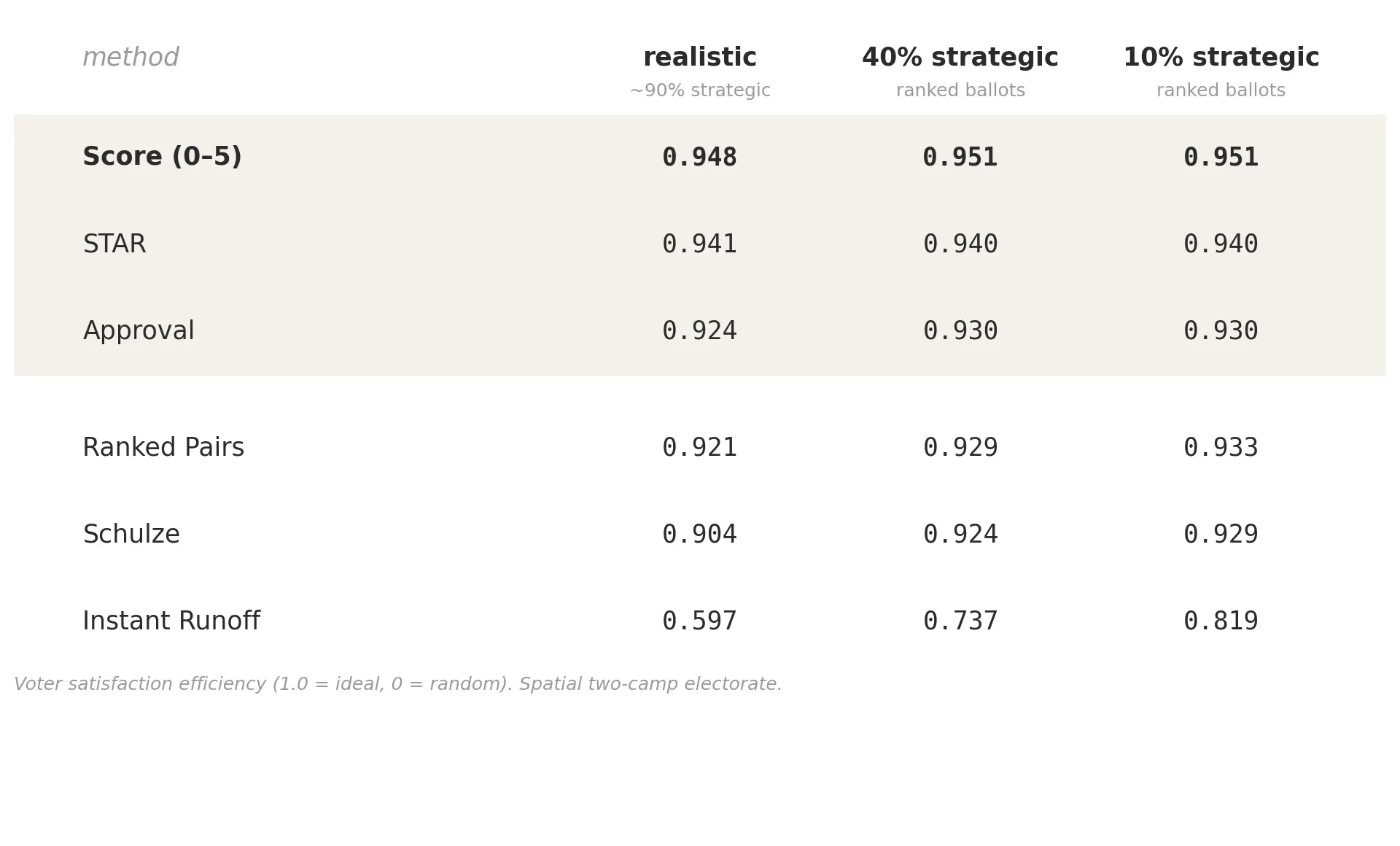
score voting is king, condorcet not so much
-
Many people treat Condorcet's VSE edge as settled. It isn't. It rests on two assumptions that quietly do all the work: that voters perceive viability perfectly, and that they mostly vote honestly. Relax either and it collapses.
I took Quinn's VSE engine and made one change. His runs let strategic voters read the true standings exactly, so their strategy is always aimed at genuinely weak candidates and barely dents Condorcet. I replaced that with a viability signal that's 50% true, 50% random, since real electorates misjudge who can win all the time (a Democrat written off in a red state, etc.). Now strategy sometimes buries a candidate who'd actually have won, the favorite-betrayal failure cardinal methods are immune to. (STAR voting technically isn't, but voters strategize intuitively would have no idea how STAR actually works, in real life—so just assume it's score voting.)
Then I rigged the rest in Condorcet's favor: cardinal methods (0–5 score, approval, STAR) run at 90% strategic; Condorcet methods get a very favorable 10% and a favorable 40% strategic. Maximum strategy against the cardinal methods, little against the ordinal ones.
Spatial bimodal electorate (two ideological camps, candidates along the axis):
method regime VSE Score (0–5) 90% strat 0.946 Ranked Pairs 10% strat 0.932 Schulze 10% strat 0.929 Approval 90% strat 0.924 Ranked Pairs 40% strat 0.918 STAR 90% strat 0.918 Schulze 40% strat 0.913 Polya / urn electorate (Quinn's default):
method regime VSE Score (0–5) 90% strat 0.876 Ranked Pairs 10% strat 0.870 STAR 90% strat 0.865 Approval 90% strat 0.858 Schulze 10% strat 0.855 Ranked Pairs 40% strat 0.854 Schulze 40% strat 0.846 Even with the deck stacked this hard, fully strategic Score beats every Condorcet configuration on both models, including the most favorable. And once a realistic 40% of Condorcet voters strategize, strategic Approval passes Ranked Pairs on both and beats Schulze across the board.
The spatial model, if anything, favors Condorcet: it puts voters and candidates on a real ideological axis where head-to-head comparisons mean the most. Score wins there anyway.
The strategy model is just frontrunner polarization, what plurality voters already do reflexively: "I don't think X can win, so I'll bury them and rank the viable compromise first." Biden > Warren > Trump, Cornyn > Talarico > Paxton. The honesty-and-perfect-viability assumptions are the only thing holding Condorcet's edge up, and neither survives contact with how people actually vote.
(±95% CIs ≈ 0.005 spatial, 0.009 Polya. Built on Quinn's engine with a half-random viability signal; happy to share the patched code.)
-
@clay Some interesting stuff there. It's been said that score suffers worse with one-sided strategy than other methods. That is - if the supporters of one candidate strategise more than the supporters of another, then the result will be more skewed (favour the strategisers) under score than some other methods. Would you agree with that, and do you see it as a problem?
-
@toby-pereira said in score voting is king, condorcet not so much:
It's been said that score suffers worse with one-sided strategy than other methods. That is - if the supporters of one candidate strategise more than the supporters of another, then the result will be more skewed (favour the strategisers) under score than some other methods. Would you agree with that, and do you see it as a problem?
I ran it on a spatial bimodal electorate with a realistic (half-random) viability signal, average strategy pinned at 90%, comparing symmetric (90% of each faction strategizes) against the most lopsided split possible at that level (100% of one faction, 80% of the other).
method 90/90 symmetric 100/80 asymmetric change Score (0–5) 0.943 0.933 −0.010 Approval 0.926 0.921 −0.005 STAR 0.914 0.905 −0.009 Ranked Pairs 0.874 0.859 −0.016 Schulze 0.863 0.840 −0.022 So at a fixed strategy level, adding maximum asymmetry costs Score about a point, and costs the Condorcet methods more, Ranked Pairs −0.016, Schulze −0.022. Approval is the most robust of all. The ordering of who's hurt is the reverse of the claim: one-sided strategy is harder on the ranked methods here than on the cardinal ones.
I'd agree the underlying property is real, score does respond to one-sided exaggeration. But two things keep it from being a problem in practice. The optimal score strategy is just threshold voting (approve/max everyone above your expected value of the winner), which is close to a sincere ballot, so the distortion per unit of asymmetry is small. And every method has an asymmetric-strategy weakness; the ranked methods' version is burial, which diverges much further from sincerity and does more damage, which is what the table shows.