RCV found unconstitutional in Maine.
-
The Supreme Court of Maine has once again ruled on the constitutionality of Ranked Choice Voting, again finding it to be unconstitutional.
In 2017 they had ruled that RCV was not compatible with Maine's requirement for a Plurality winner (the candidate with the most votes wins). In RCV, ballots are initially counted as votes for first-choice candidates, but those same votes can later be transferred or discarded, meaning the final winner may not be the candidate who received the most votes as originally cast.
“The Constitution requires that the person elected shall be the candidate who receives a plurality of all the votes.”
“Under the ranked-choice voting system… if no candidate receives a majority of first choice votes, the last-place candidate is eliminated and the votes cast for that candidate are redistributed to the voters’ next choices.”
“It is therefore possible that the candidate who receives the greatest number of first choice votes will not be declared the winner.”
“Because the Act requires the Secretary of State to determine the winner… by eliminating candidates and redistributing votes until one candidate receives a majority, the [Ranked Choice Voting] Act is not consistent with the provisions of the Constitution that require election by plurality.”
-Opinion of the Justices (Maine 2017 RCV Advisory Opinion)The new 2026 ruling takes a look at the conflicting Alaska court ruling on the same subject and once again rules that RCV can find and then reject the plurality winner in favor of someone else.
The new ruling also goes deeper into the 2nd RCV constitutional issue, regarding centralization of ballots required under RCV.
Article IV, Part First, § 5 (House)
“The votes shall be received, sorted, counted and declared in open ward, town and plantation meetings…”
Article IV, Part Second, § 3 (Senate)
“The votes shall be received, sorted, counted and declared in the same manner as votes for Representatives…”
Article V, Part First, § 3 (Governor)
“The votes shall be received, sorted, counted and declared… and the lists of votes shall be sealed and returned to the Secretary of State…”
RCV does not allow for local tabulation of ballots due to the fact that a local or subset of ballots isn't enough to determine the order of elimination, thus there's no way to know which rankings and transfers should be counted and which ballots should be exhausted until the central tally is complete. The Maine Constitution requires that votes be counted and declared by local officials as cast, with those results transmitted to the state.
This has massive implications for RCV nationwide. 39 states include a clause of some sort requiring Plurality winners in their elections. 8 states include a clause requiring local tabulation and reporting of vote totals in their constitutions.
RCV also violates common clauses in state constitutions that Maine doesn't have, including "vote for one" clauses, "count all votes" clauses, and "Equal Vote" clauses. Many more states have laws similar to those above that implicitly exclude RCV, and now 19 states have explicit bans on RCV.
For decades the argument in the voting reform community has been that we should go with RCV (despite warnings from the electoral science community) because of momentum. I think that argument can now officially be laid to rest.
It's worth noting that STAR Voting and Approval Voting both comply with the Maine Constitution's plurality winner rule. STAR Voting only finds the Plurality winner once, in the Automatic Runoff round. It clearly defines the vote as the runoff vote and defines scores as ballot data - not votes. Votes are never reassigned, transferred, or exhausted. Your vote goes to the finalist you prefer or counts as equal support for both, essentially like an abstain between those two. The candidate with the most votes wins.
STAR also is compatible with local tabulation of ballots, (subtallies report score totals for each candidate and a voter preference table). In STAR all ballot data is fully counted and used.
It's time that we as a movement recognize that RCV is a dead end and stop throwing good money after bad.
-
@sarawolk that’s unfortunate, but is this about ranked ballots in general or about instant runoff voting? I hope the latter.
I still think approval is the best path forward.
cardinal-condorcet [10] ranked-condorcet [9] approval [8] score [7] ranked-bucklin [6] star [5] ranked-irv [4] ranked-borda [3] for-against [2] distribute [1] choose-one [0]
-
@cfrank This is about Ranked Choice Voting, ie Instant Runoff Voting. Not ranked ballots in general.
PSA: Ranked voting is a great umbrella term. "Ranked Choice Voting" is only an umbrella term for IRV and STV. It does not and never has referred to other ranked methods outside that family. It was explicitly coined for IRV by Fan Francisco, who thought the term "instant" was misleading for voter education since the results are not instant with IRV.
At some point Equal Vote started incorrectly sharing something to the contrary, but we were wrong.
It's really important to differentiate from Ranked Choice Voting, so it's really important that we stop using the term for other ranked methods.
-
@sarawolk makes sense. “Ranked voting” (or rank-based voting?) is a good way to refer to the ballot format rather than IRV. I’ll use something like that from now on, not “ranked choice voting.”
-
@sarawolk said in RCV found unconstitutional in Maine.:
The Supreme Court of Maine has once again ruled on the constitutionality of Ranked Choice Voting, again finding it to be unconstitutional.
In 2017 they had ruled that RCV was not compatible with Maine's requirement for a Plurality winner (the candidate with the most votes wins). In RCV, ballots are initially counted as votes for first-choice candidates, but those same votes can later be transferred or discarded, meaning the final winner may not be the candidate who received the most votes as originally cast.
...
It's worth noting that STAR Voting and Approval Voting both comply with the Maine Constitution's plurality winner rule. STAR Voting only finds the Plurality winner once, in the Automatic Runoff round. It clearly defines the vote as the runoff vote and defines scores as ballot data - not votes. Votes are never reassigned, transferred, or exhausted. Your vote goes to the finalist you prefer or counts as equal support for both, essentially like an abstain between those two. The candidate with the most votes wins.
This seems slightly tenuous. I don't think we can go by how STAR defines itself by saying that only the runoff is "the vote". Otherwise IRV / RCV could just redefine itself to declare that only the final runoff is "the vote".
The point is that it's surely about how this supreme court defines a vote, not how an individual voting method does.
-
@toby-pereira
In RCV a vote is the voters top choice in the first round and each round following. The first round finds the Plurality winner and if that candidate has a majority of active votes the election is called right then and there, but if that winner has a plurality of votes but not a majority of active votes, the system may reject that and go on to find a separate winner by reallocating or exhausting those votes. That's why it's not a Plurality method.In STAR Voting the first round never determines a winner because votes haven't been awarded to candidates yet. That always happens only once in STAR Voting and the candidate with the most votes always wins.
-
@sarawolk said in RCV found unconstitutional in Maine.:
@toby-pereira
In RCV a vote is the voters top choice in the first round and each round following. The first round finds the Plurality winner and if that candidate has a majority of active votes the election is called right then and there, but if that winner has a plurality of votes but not a majority of active votes, the system may reject that and go on to find a separate winner by reallocating or exhausting those votes. That's why it's not a Plurality method.In STAR Voting the first round never determines a winner because votes haven't been awarded to candidates yet. That always happens only once in STAR Voting and the candidate with the most votes always wins.
Right, so you're saying that because the IRV counting process could end after any round, it is necessary to call each round a vote.
However, IRV does not need to use the counting process where it stops in the round when a candidate first has a majority. It could just continue until there are two candidates left and just call that final round "the vote". It would never affect the (first place) result, but would just require a bit of extra counting.
But regardless, as I say, I'm not sure a voting method's own definition of what a vote is would hold any weight against what a court says a vote is.
And even if we allow that, by calling just the final run-off in STAR the vote, the method is also excluding most of the candidates from the voting process, which I think might be considered unconstitutional.
Obviously it's not me you would be arguing against, but these are just things that I can imagine might come up.
-
@toby-pereira I’m sure the courts will conjure up whatever question-begging definition of vote they need to for whatever ruling they decided on beforehand. I think getting the reasonable notions settled on to facilitate progress without constitutional amendments will require more lawyering than only appeals to reason. It’s unfortunate that Maine’s constitution encoded plurality into its state voting law, I think it’s important to know what other states might have this same kind of language issue in their constitutions.
-
@cfrank Sara and I disagree on the terminology. My position is that the qualifier Ware makes clear what tallying is called in. So, Ware RCV for the specific system that Rob Ritchie & co. are promoting.
-
In the Electoral Methods e-mail broadcast, Etjon Basha asks, "So, not even approval would pass? Nothing beyond plurality?".
Approval, Score, STAR [10], other Shentrup/Frohnmayer balance-compliant systems [9]; everything else [0].
-
@sarawolk said in RCV found unconstitutional in Maine.:
It's really important to differentiate from Ranked Choice Voting, so it's really important that we stop using the term for other ranked methods.
I think a much better strategy is to just ask "which type of ranked choice voting?" Because 90% of people who like "RCV" have only a superficial understanding of the topic and aren't thinking beyond the ranked ballot, and this keeps them open to considering alternative methods of tallying those ballots. As a friend said to me in person "I don't know about all that, I just want to rank the candidates".
-
Etjon Basha asks, "So, not even approval would pass? Nothing beyond plurality?".
In this context, "plurality" doesn't mean "Choose One Only" Voting or FPTP. Plurality means a class of systems where the candidate with the most votes wins, as opposed to "majority" voting systems in which the candidate with the majority of votes cast wins.
Approval is a plurality method.
-
@psephomancy Even if we wanted to, redefining the term "Ranked Choice Voting" isn't within our power. They have clear and defensible trademark over the term, which again, was coined specifically for IRV, not to mention name recognition for RCV by millions of people that they've invested millions of dollars to build.
Terminology in voting science is already so jumbled. Conflating good ranked methods (Condorcet) with Ranked Choice Voting (IRV & STV) or Instant Runoff Voting (IRV only) is only going to hurt the better options in the scenarios where RCV is a dirty word, while in contexts where RCV is well regarded, conflating better ranked methods serves no benefit because RCV dwarfs all the other alternatives in terms of name recognition and market dominance.
Our only way forward here is to out RCV as the outdated and oversold method that it is, position better alternatives as the successor, and move forward from there. Strategically.
-
@toby-pereira Anything can be argued and counter-argued in court, but my assessment above is based on what a fair and likely ruling would be, in my professional opinion.
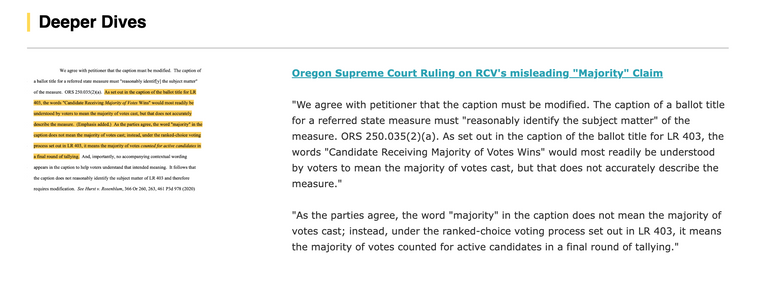
I'm not a lawyer, but have been studying these things for years and we did win the case in the Oregon Supreme Court against the Oregon Legislative Council which found that RCV's ballot title in Oregon was misleading and inaccurate as it pertains to RCV's majority winner claims, though there is apparently no mechanism anymore to enforce such a ruling.
Two confounding data points:
- RCV has spent years making the argument that RCV guarantees majority winners. That's directly at odds with an argument that it guarantees plurality winners. Ironically, there's a solid case to be made that due to exhausted ballots it guarantees neither.
- The Constitution of Maine Article IV, Section 5 requires that winners be elected "by a plurality of ALL votes returned.” In cases like these where the wording is explicit that it's "all" votes "returned" or all votes "cast" RCV is eliminated from compliance by the existence of exhausted ballots alone.
-
@cfrank I wish I had time to program a bot to have me reply here every time anyone mentions "approval" and remind everyone to clarify as "choose-any" until we eventually shift the terminology. "Approval" is a bad name with wrong implications (we can vote our preferences whether we approve or disapprove of every candidate). "Choose-any" needs to be the term. And we need to keep at it until it becomes the norm.
(But I'm just procrastinating by replying here, I have major other life stresses to go deal with)
-
@sarawolk FTFY
Choose-any (aka 'Approval') is a plurality method.
-
@wolftune that's reasonable, I think the "approval" ("choose-any") community would have to converge on that but it's worth pushing. All the nomenclature we use should definitely be standardized.
cardinal-condorcet [10] ranked-condorcet [9] approval [8] score [7] ranked-bucklin [6] star [5] ranked-irv [4] ranked-borda [3] for-against [2] distribute [1] choose-one [0]
-
@cfrank I thought it through deeply enough (you might find some old post about it from me from long while back), and I got enough initial reactions. Conclusion for now is: this will be a bottom-up change. The people who have invested in "Approval" are too hesitant to embrace a rebrand and aren't facing enough catastrophic rejection or something to force it. You can test for yourself that every naive lay person off the street understands SO MUCH more readily when you say "Choose any" rather than "Approval" (and that they also feel constricted about "approving" candidates rather than just voting for preferences, as in how people don't approve of lesser-evils but do vote for them)
So, I think the more people just say "Choose-any (aka Approval)" over and over, there will be a slow shift to more and more use of just "choose any" until that just becomes the norm and the main advocates embrace it too. This bottom-up approach is the best path forward IMO, but I'll be happy for anything that fixes this problem.
-
@wolftune There is this thread from 2024. I think it might have passed me by at the time. I see your point about it being clearer about what it does, but on the other hand, it's not something I've really thought about, so I don't think I will suddenly change my language immediately based on this. It's quite a big thing to do, and I think I would need to see that there is a larger consensus in the general voting community that this is the best name, rather than just individuals deciding one at a time.
Edit - Thinking about it, "Choose-any" comes across as ambiguous to me. It could come across as "choose any one".
-
@toby-pereira could be “choose however many” but that doesn’t roll off the tongue per se.